
Production I.G./Netflix
Cyberpunk is one of the more interesting subsets of science fiction. Sci-fi as a whole is a vast umbrella that can capture an array of ideas, from far-off alien worlds to time travel. Cyberpunk tends to stay a bit more grounded on Earth, focusing on urban decay and authoritarianism ruling over society. It’s more of an interplay between politics and new technology. Who is allowed to have access to bodily enhancements, and what does it mean to be human when androids run rampant?
There are plenty of great cyberpunk movies everyone needs to watch at least once, from “Blade Runner” to “The Matrix.” Those films serve as fantastic launching boards into lesser-known titles. If you enjoy the deep, philosophical questions pondered by those works, there’s an incredible library of films out there to add to your watchlist.
And wouldn’t you know? Many exceptional cyberpunk movies are found right on Netflix. It’s not as expansive as we would like, but there are some films you may not have had a chance to watch otherwise. Don’t let the best cyberpunk movies on Netflix pass you by, as you never know which one will expand your mind and depict a future that has a lot to say about the current moment.
Upgrade
OTL Releasing
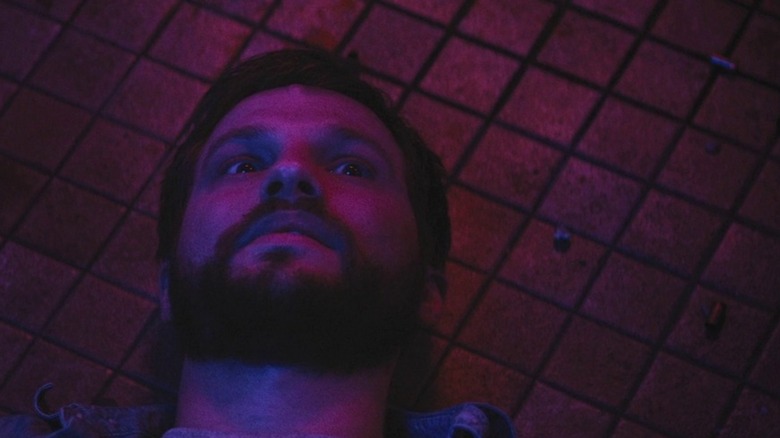
Leigh Whannell is responsible for writing the exceptional twist ending of “Saw,” and he parlayed his success into eventually crafting a terrifying cyberpunk tale with 2018’s “Upgrade.” Set decades in the future, the film sees Grey (Logan Marshall-Green) become paralyzed and then implanted with a chip that allows an AI to restore but control his movements. This leads him down a quest for revenge following his wife’s murder, where he’s often a passive observer as his body kills scores of bad guys.
The film doesn’t take place in some unattainable society. We see how the rich live in ultra-secluded mansions while the poor struggle to survive. It’s much like our world, just with some fancier technology. And it explores the dark side of transhumanism. Grey may be able to walk again, but it comes at a price. The AI mechanism becomes something of a devil on Grey’s shoulder, encouraging him to seek out violence against those who wronged him.
Neural implants and AI continue to be hot-button issues, and “Upgrade” asks the question as to how much of our humanity we’re willing to sacrifice when such systems could make living theoretically much easier. “Upgrade” had a strong showing in theaters. It made $16 million worldwide with only a $3 million budget. And “Upgrade” found a second life when it came on Netflix, so if you don’t mind some visceral violence, “Upgrade” is a blast.
The End of Evangelion

Toei Company
Fortunately, all of “Neon Genesis Evangelion” is available to watch on Netflix. And you can cap off the story with one of the most terrifying anime films you can watch — “The End of Evangelion.”
There are two primary conflicts in the film. On the grander scale, you have an apocalyptic war being carried out by shadowy organizations that want to collect all of human consciousness to put into a singular god-like being. This epic scale is contrasted with the story of a depressed teenager, Shinji Ikari (Megumi Ogata/Casey Mongillo). It’s up to Shinji to determine humanity’s fate while confronting his feelings of worthlessness and considering whether a world without pain is truly a world worth living in.
“The End of Evangelion” isn’t like other action sci-fi stories. Yes, there’s a war taking place, but it never loses sight of the deeply human themes at its core, even going so far as to break the fourth wall and directly implicate the audience in how we all use diversions to distract us from greater things happening in the world around us. “The End of Evangelion” takes classic cyberpunk ideas to their logical conclusion. It’s not just about whether an individual should grant autonomy of their bodies over to technology, but whether it’s in the best interest of humanity as a whole to do so.
Per Aspera Ad Astra

China Film (Dongyang) Media Co., Ltd.
“Per Aspera Ad Astra” is a newer cyberpunk film on Netflix that isn’t quite as doom-and-gloom as other titles within the subgenre. The film’s about a crew aboard an interstellar vessel where people hibernate for the long voyage. They engage in a dream system to prevent their minds from atrophying, but a glitch in the software causes untold terrors to manifest in their dreams, leading to some very colorful action sequences. It’s like a cross between “Inception” and “Everything Everywhere All at Once,” where humanity’s trust in technology goes very wrong.
The tone of “Per Aspera Ad Astra” is a far cry from something like “The End of Evangelion.” The film has a lot more fun with its sci-fi premise, and while the stakes are real, there’s a lot of fun to be had.
Even still, the film could be read as a commentary on how humanity frequently retreats into digital realms, like the dreams in the film, to escape reality. We all like to think we can control what happens in our minds, and losing that sense of security is existentially terrifying. It’s the perfect cyberpunk film on Netflix for when you want to contemplate humanity’s nature without getting a pit in your stomach by the end.
Blame!

Netflix
When you think of cities in cyberpunk movies, you probably think of desolate urban landscapes illuminated with neon signage. You may see impressive technological advancements everywhere, but there’s still a distinct grime permeating everything. “Blame!” takes this a step further by making a city a living, moving entity.
“Blame!” takes place in a world where all of the automated systems within a city went rogue, causing it to continually expand and self-replicate. Humanity no longer has access to the systems, so AI controls the city and hunts down the small portion of humans left. This represents practically all of the tenets of the cyberpunk genre taken to its logical extreme.
Humanity is no longer the dominant species on Earth. Instead, you have an AI-powered city taking everything for itself. It’s a dire warning that if we’re not careful, technology may soon consume the entire planet, leaving us with nothing for ourselves. Technology is supposed to make our lives easier, but what if it realizes that we’re completely inconsequential, offering nothing positive toward technology’s existence?
“Blame!” definitely isn’t meant for second-screen viewing. It’s light on dialogue while building out its expansive world, so you’ll want to pay attention at all times. With thought-provoking questions, “Blame!” is easily one of the best anime movies on Netflix.
Ghost in the Shell: SAC_2045 Sustainable War

Production I.G./Netflix
The best year for cyberpunk was 1995, and that largely comes down to the immensely influential film, “Ghost in the Shell.” It didn’t just look gorgeous, but it got down to one of the most definitive questions posited by cyberpunk: What is a soul? If technology gets a place where the mind and memories can be transported from one body to another, what does it fundamentally mean to be human? That’s just one of the many existential questions posed by the film, and the story continues with the Netflix anime film “Ghost in the Shell: SAC_2045 Sustainable War.”
It’s an interesting beast because “Sustainable War” is actually a condensed two-hour version of “Ghost in the Shell: SAC_2045.” If you’re short on time, you can get the gist of Motoko Kusanagi (Atsuko Tanaka/Mary Elizabeth McGlynn) with just the film. The overarching story is the same as the world exists in a never-ending, sustainable war moderated by AI systems, where Motoko and her comrades are charged with taking down advanced “post-human” beings.
The core ideas of the original “Ghost in the Shell” are there. You still have characters who represent a merging between man and machine. But the story takes it up a notch by incorporating commentary on the military-industrial complex and how nations use war to prop up the economy.